Date: May 15, 2026
Author: Kyiv Institute for European Integration (KIEI)
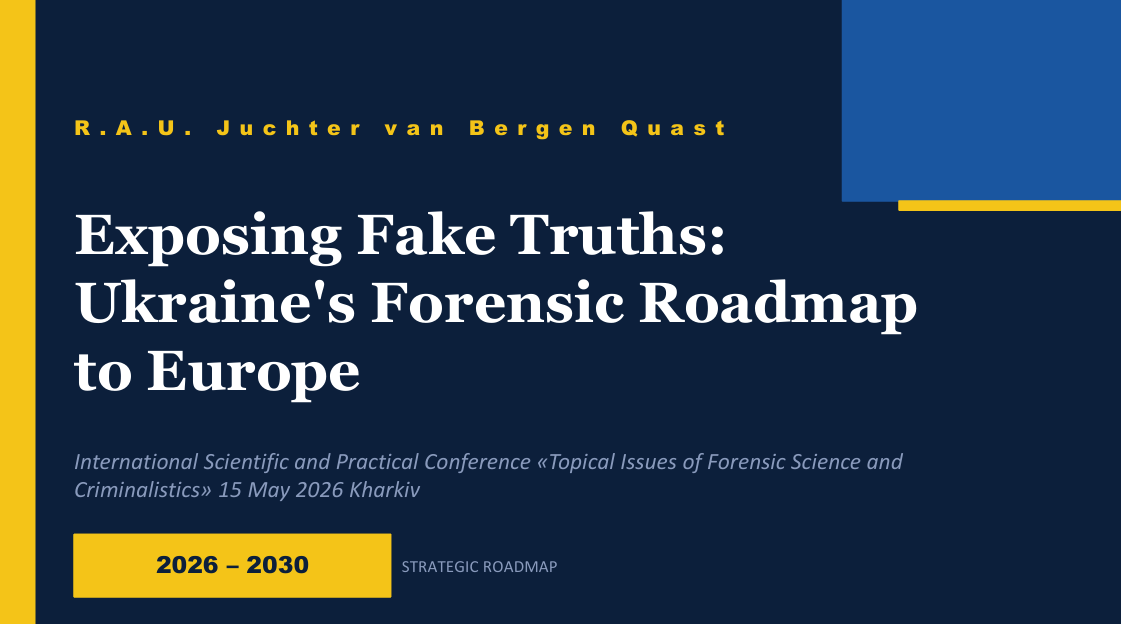
On May 15, 2026, the Kyiv Institute for European Integration (KIEI) proudly participated in the International Scientific and Practical Conference «Topical Issues of Forensic Science and Criminalistics» held in Kharkiv.
Following an important lecture by the esteemed Prof. Dr. phil. h.c. Dr. phil. h.c. Moritz Hunzinger, KIEI Managing Director R.A.U. Juchter van Bergen Quast delivered a crucial presentation titled “Exposing Fake Truths: Ukraine’s Forensic Roadmap to Europe“. His address focused on the urgent need for legal and regulatory harmonization of forensic activities in Ukraine to support its European integration.
The urgent need for forensic reform
With over 50,000 war crimes registered since February 2022 and 85% of criminal cases now involving digital evidence, the stakes have never been higher. The integrity of Ukrainian forensic evidence is no longer just a domestic issue—it is a matter of international justice, EU accession, and national sovereignty.
Currently, hostile actors exploit vulnerabilities in the system to introduce fabricated evidence. Outdated legislation, such as the 1994 forensic law, lacks robust digital standards, allowing fabricated data to enter courts unchallenged. Furthermore, a lack of widespread ISO accreditation leaves Ukrainian lab results vulnerable to being discredited by defense counsel or hostile states in international courts.
As Mr. Juchter van Bergen Quast noted, “Science is the most powerful weapon against a lie.” However, every gap in our current forensic system is a door left open for lies to walk through.
The 2026–2030 strategic roadmap
To secure justice and facilitate EU accession, KIEI outlined a comprehensive Four-Phase Roadmap spanning from 2026 to 2030:
- Phase 1: Close the Back Door (2026-2027) The immediate priority is to seal the legal voids exploited by fake digital evidence. This includes updating the Criminal Procedure Code (CPC) to properly recognize digital evidence (smartphones, cloud data, IoT) and ratifying the Budapest Convention on Cybercrime to establish cross-border verification tools.
- Phase 2: Build the Truth Shield (2027-2028) To ensure our evidence survives any challenge in any court, Ukraine must mandate ISO/IEC 17025 accreditation for its laboratories. Additionally, adopting European Network of Forensic Science Institutes (ENFSI) evaluative reporting will replace vague opinions with quantifiable probability.
- Phase 3: Break the Monopoly (2028-2029) Forensic truth must be independent. This phase calls for ending centralized ministry control by establishing a unified, independent Qualification Body. This ensures transparent methodologies that cannot be altered for political convenience.
- Phase 4: No More Plausible Lies (2029-2030) The final phase focuses on the future: deploying AI and biometric tools under EU judicial oversight to spot fabricated identities and tampered media at scale. Ultimately, this leads to full integration into the European Forensic Science Area (EFSA 2030), ensuring Ukrainian findings hold equal legal weight in every European court.
A call for political action
A lie only survives where the truth cannot be proven. To make this roadmap a reality, KIEI calls on policymakers to act on five key political asks:
- Pass CPC amendments on digital evidence this session.
- Mandate ISO 17025 accreditation by 2028.
- Create an independent Unified Qualification Body.
- Secure EU funding for mobile forensic labs to document war crimes to ICC standards.
- Commit to EFSA 2030 with a binding plan.
By implementing these reforms, Ukraine will not only hold war criminals accountable but will also become a regional leader in forensic truth and a model for post-conflict accountability.
The Institute is deeply grateful to Mrs. Daryna Kupriianova for her essential support.
To learn more about our work on European integration and legal harmonization, explore our resources at KIEI.
No responses yet