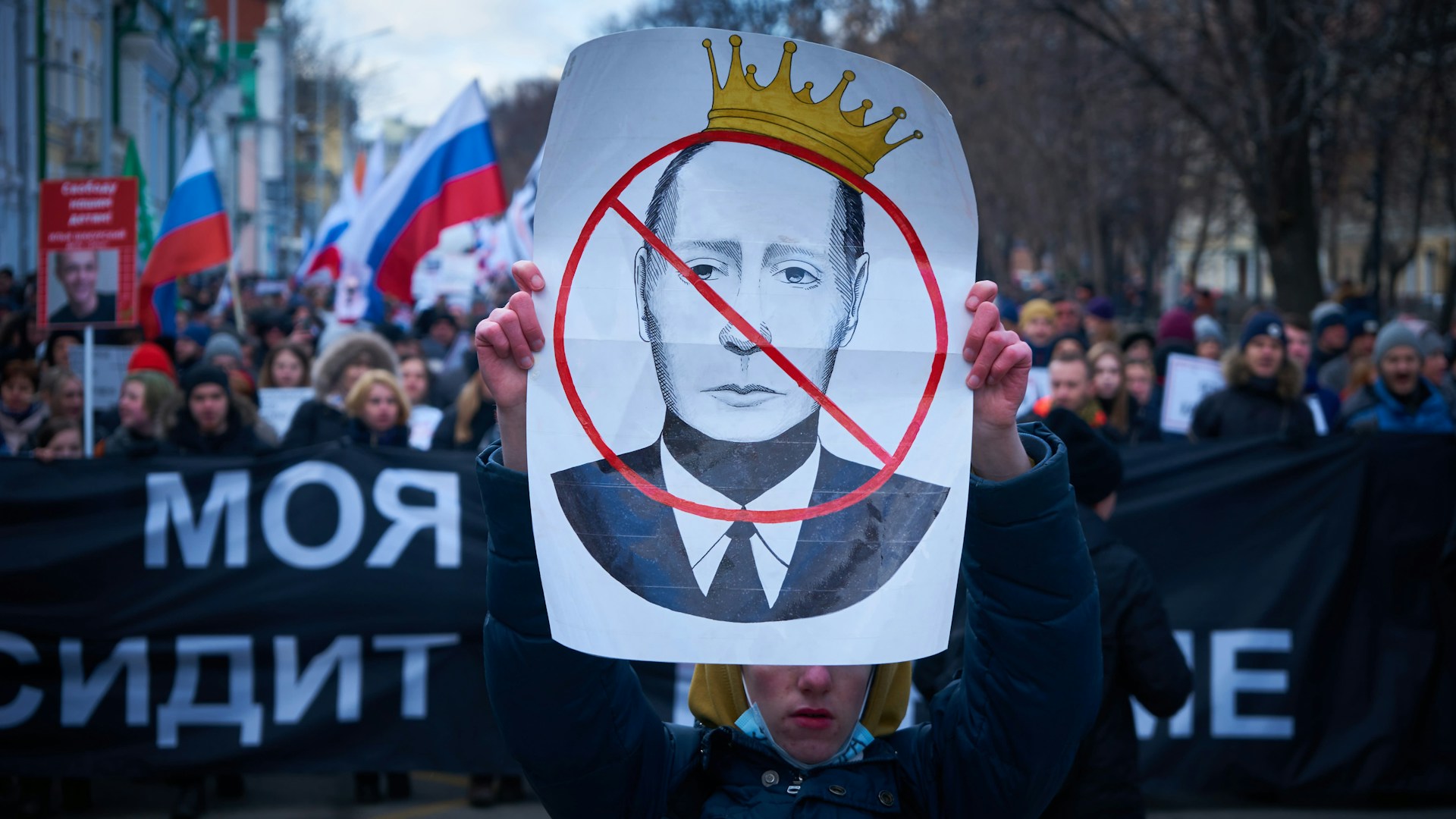
The peace trap
Executive summary: the cycle of perpetual conflict
As the war in Ukraine drags toward the end of 2025, a familiar and disturbing cycle has emerged in global geopolitics. The pattern is distinct: Ukraine proposes security initiatives; Europe commits to long-term support; the United States engages diplomatically. And every single time, Russia rejects the off-ramp.
Diplomats and analysts often throw up their hands, citing a “lack of intent” from the Kremlin. They argue that Vladimir Putin simply does not want peace yet. But this analysis misses the darker, more visceral driver of the war. The “absence of intent” hides a terrifying reality: For Vladimir Putin, the war has ceased to be a tool of foreign policy. It has become a necessary shield against his own inner circle.
This report posits that the deadlock observed in late 2025 is not a failure of diplomacy, but the result of a survival strategy. The war will continue not because Russia can win, but because Putin cannot afford to stop. He has burned the bridges behind him, and the only path that keeps him in power—and perhaps alive—is the path of perpetual conflict. To end this war, the West must understand that it is not negotiating with a leader fighting for his country’s future, but with a man fighting for his own physical survival.
The following analysis is exhaustive. It dismantles the “rational actor” model often applied to the Kremlin, replacing it with a “survivalist” model. It examines the internal shark tank of the Russian elite, the economic trap of military Keynesianism, and the psychological dominance of the “peace trap.” It argues that as long as the cost of peace (personal demise) remains higher than the cost of war (state degradation), the conflict will endure.
The autocrat’s dilemma
We often assume that wars end when the cost of fighting exceeds the potential gain. But for an autocrat like Putin, the calculus is different. In the unforgiving ecosystem of the Kremlin, a peace deal that involves compromise—returning territory, paying reparations, or accepting security guarantees for Ukraine—is not viewed as statesmanship. It is viewed as weakness. And in the world of the Russian elite, weakness is often fatal.
Putin is currently riding a tiger. As long as he stays mounted—keeping the country on a war footing, mobilizing the economy against a “foreign enemy,” and suppressing dissent under the guise of wartime necessity—he remains the indispensable Commander-in-Chief.
The divergence of state and personal utility
To understand the 2025 deadlock, one must distinguish between the utility function of the Russian state and the utility function of Vladimir Putin.
For the Russian State, the rational choice in 2025 is peace. The economy is overheating; demographics are collapsing; and the technological gap with the West is widening. A rational state actor would cut losses, secure the land bridge to Crimea if possible, and pivot to reconstruction.
For Vladimir Putin, the rational choice is continued war. Peace brings scrutiny. Peace lifts the censorship laws that protect him. Peace allows the elite to assess the damage.
- War utility: High control, suspension of elections, suppression of rivals, unified nationalist narrative.
- Peace utility: Economic recession, angry veterans, elite infighting, potential tribunals.
This divergence creates the trap. The state bleeds so the leader can breathe.
Historical precedents of the trap
History is replete with autocrats who could not afford peace.
- Nicholas II (1917): The Tsar could not exit World War I without admitting defeat, which would destroy the legitimacy of the monarchy. He fought on until the system collapsed from within.
- Slobodan Milošević (1990s): He sustained power through serial conflicts (Slovenia, Croatia, Bosnia, Kosovo). When the wars stopped and the “victory” narratives collapsed, he was overthrown and sent to The Hague.
- Muammar Gaddafi (2011): Putin reportedly watched the videos of Gaddafi’s death obsessively. The lesson he internalized was that “compromise” (Gaddafi giving up his WMD program in 2003) leads to weakness, and weakness leads to death.
Putin views the “peace process” not as a negotiation but as a prelude to a courtroom or a lynch mob.
The Dresden trauma: when Moscow was silent
The psychological roots of this fear can be traced back to a specific night that shaped Putin’s worldview. On December 5, 1989, shortly after the fall of the Berlin Wall, a 37-year-old Lieutenant Colonel Putin watched from inside the KGB villa in Dresden as an angry mob stormed the Stasi headquarters across the street. As the crowd turned toward his building, Putin desperately called the local Red Army tank unit for protection. The officer on duty replied that he could not send help without orders, and “Moscow is silent”.
Abandoned by his own government, Putin was forced to confront the mob alone, bluffing that his guards were armed and would shoot, while inside, he and his colleagues frantically burned intelligence files until the furnace burst. The trauma of that night—the paralysis of power, the silence of the central government, and the visceral threat of a lynching—instilled in him a permanent fear of losing control. He learned that when a leader shows weakness, the system collapses, and the mob comes for the survivors. In 2025, he refuses to end the war because he refuses to ever let Moscow be “silent” again.
The internal sharks
The biggest threat to Putin’s life is no longer the Ukrainian army or NATO expansion; it is the siloviki (security elites) and the ultra-nationalists he spent decades empowering.
The ecology of the Kremlin elite
Consider the position of the Russian elite in 2025:
- They have lost billions in sanctions.
- They are cut off from their villas in Europe.
- They have seen their influence humiliated on the global stage.
They have tolerated these losses on the promise of a “Great Victory.” If the war ends without that victory—if Putin signs a peace deal that looks like a draw—the justification for their sacrifice evaporates. The moment the guns fall silent, the factions that have bled equity and influence will look for a scapegoat. Putin knows that he would be that scapegoat.
The siloviki factions
The siloviki are not a monolith. They are a collection of competing clans, currently united only by the war.
- The FSB (Federal Security Service): Hardliners who believe in the existential struggle against the West. They view any peace deal as treason.
- The Army general staff: Humiliated by the failures of 2022-2023, they fear a post-war inquiry that would expose their corruption and incompetence. They prefer the “fog of war” to remain thick.
- The military-industrial complex: This sector is currently booming. Directors of tank factories and missile plants have become the new oligarchs. Peace means their budgets are cut.
These groups are the “sharks” circling the raft. As long as Putin feeds them war (budgets, powers, enemy narratives), they refrain from eating him. If he stops the war, he becomes the meal.
The ultra-nationalist threat
Putin has empowered a class of “turbopatriots”—military bloggers, volunteer commanders, and ideologues—to generate support for the war. These groups are more radical than Putin. They demand total victory: the capture of Kyiv and the erasure of Ukrainian identity.
A compromise peace would be viewed by this demographic as a “stab in the back” (Dolchstoßlegende). Unlike the liberal opposition, which is unarmed and dispersed, the nationalist opposition is armed, combat-experienced, and organized. Putin fears a coup from the right far more than a revolution from the left.
The danger of “peace”
This creates a paradoxical danger. The West keeps offering “off-ramps,” assuming Putin is a rational actor looking for a way out. But Putin likely views these off-ramps as trapdoors.
Why off-ramps fail
- Continued war grants him total control, emergency powers, and a unified narrative.
- Peace brings a domestic reckoning: an economy overheating from military spending, returning soldiers angry at the command structure, and an elite circle sharpening their knives.
He isn’t just rejecting peace terms because he thinks he can still take Kyiv. He is rejecting them because he is avoiding the conversation that awaits him in Moscow the morning after the treaty is signed.
The post-war reckoning
Imagine the scenario of a peace treaty in 2026:
- The Soldier’s return: Hundreds of thousands of men return from the front. They are traumatized, armed, and feel betrayed by a leadership that failed to deliver the promised victory.
- The Economic crash: The defense orders stop. Factories fire workers. The artificial GDP growth driven by military spending collapses.
- The Blame game: The elite asks, “Who lost Ukraine?” The answer leads inevitably to the top.
To avoid this, Putin chooses the “forever war.” It is a stasis where the disaster is always postponing, never arriving.
The economy of the peace trap
The economic dimension of the trap is often overlooked. By 2025, Russia has transformed into a war economy.
Military Keynesianism as a drug
The Russian economy is currently addicted to military spending. The state is pumping trillions of rubles into the defense sector. This has created:
- Low unemployment: Because millions of men are at the front or working in defence plants.
- High wages: In the defense sector, driving up consumption.
- GDP growth: On paper, the economy looks like it is growing.
But this is “bad” growth. It is the production of things that destroy or are destroyed. It does not build long-term wealth.
The recession of peace
If peace breaks out, the spending stops.
- Demand shock: The defense sector contracts immediately.
- Supply shock: Soldiers return to a labour market that cannot absorb them.
- Inflation: The monetary overhang from years of printing money hits the civilian sector.
Putin knows that economic crises are the classic trigger for regime change. By continuing the war, he maintains the illusion of economic stability. He pushes the inevitable crash into the future.
The mechanics of the survival strategy
To fully grasp the “peace trap“, we must dissect the mechanisms Putin uses to maintain his position on the tiger’s back.
The information space: reality inversion
The Kremlin has constructed a hermetically sealed information environment. In this world, Russia is not the aggressor but the victim. The war is not a choice but a necessity imposed by “Western Satanism.”
This narrative is a one-way street. You can escalate it (e.g., “We are fighting all of NATO now”), but you cannot de-escalate it without breaking the reality tunnel. If Putin were to say, “We have achieved our goals and will now make peace,” the cognitive dissonance would shatter his support base. The propaganda machine has been running at 100% capacity for three years; it has no reverse gear.
The repression apparatus
The war has provided the pretext for the total dismantling of civil society.
- Treason laws: Expanded to cover almost any dissent.
- Foreign agent laws: Used to seize assets and silence critics.
- Surveillance: The implementation of digital totalitarianism (facial recognition, internet sovereignty).
Peace removes the “wartime necessity” justification for these measures. A return to “normalcy” would create space for grievances to air. Putin cannot afford space. He needs the suffocating tightness of the war to prevent the elite and the street from organizing.
The geopolitical dimension: the China factor
The “peace trap” is also reinforced by Russia’s dependency on China.
The junior partner trap
By 2025, Russia is economically and diplomatically dependent on Beijing. China buys Russia’s oil and sells it the dual-use technology needed for the war.
- China’s interest: Beijing benefits from a distracted West and a dependent Russia. It does not want a Russian collapse, but it also does not necessarily want a strong, independent Russia reconciling with Europe.
- The leverage: If Putin sought a peace deal that Beijing disapproved of (e.g., one that pivoted Russia back toward the West), China could strangle the Russian economy overnight.
Thus, Putin is trapped not only by his internal sharks but by his external patron. He must keep the war going to remain useful to Beijing as a disruptor of the Western order.
Scenarios for 2026 and beyond
Given the “peace trap,” what are the likely trajectories for the conflict?
Scenario 1: the long grind
The most likely scenario is the continuation of the current attrition war.
- Mechanism: Putin keeps feeding men and money into the front to prevent collapse, but lacks the strength for a decisive breakthrough.
- Outcome: A “forever war” that slowly bleeds Russia dry, ending only when the economic machine breaks or Putin dies.
Scenario 2: the catastrophic collapse
The “1917 Scenario.”
- Mechanism: The cumulative stress of the war triggers a systemic failure—a mutiny at the front, a sudden currency collapse, or a breakdown in logistics.
- Outcome: The elite panic and move against Putin to save themselves. The war ends chaotically, followed by a period of instability.
Scenario 3: the escalation gamble
To break the deadlock, Putin might choose to escalate dramatically.
- Mechanism: Tactical nuclear use or a direct attack on NATO assets to force a negotiation on his terms.
- Outcome: High risk of global conflict. This is the “Samson Option”—pulling the temple down on everyone.
Breaking the trap: a strategy of functional defeat
If standard diplomacy fails because the adversary’s goal is regime survival rather than state interest, Western strategy must pivot. The goal shifts from persuading Putin to stop, to disabling his ability to continue, thereby forcing the elite’s hand to intervene.
Functional defeat and strategic neutralization
The West must abandon the hope of a negotiated settlement with the current regime and adopt a strategy of “strategic neutralization”. This involves building Ukraine into a “steel porcupine”—a state so heavily fortified and integrated with Western defense industries that Russian military objectives become operationally impossible.
- Denial of victory: When the elite realize that the “Great Victory” is physically impossible, Putin’s central promise—that the war will restore Russian greatness—collapses.
- Operational paralysis: By systematically targeting logistics and command nodes, Ukraine can render the Russian military ineffective without necessarily needing to recapture every inch of territory immediately.
Severing the shadow lifelines
Putin’s war economy relies on a “shadow” network to bypass sanctions and keep the elite fed. To fracture the elite, the West must target these specific revenue streams:
- The shadow fleet: Aggressively interdicting the ghost tankers that export Russian oil above the price cap.
- Dual-use goods: Cracking down on the third-country intermediaries (in Central Asia and China) that supply the microchips and technology vital for the war machine.
- Elite assets: Moving beyond general sanctions to target the specific, hidden wealth of the siloviki families, making their continued loyalty to Putin more expensive than their potential defection.
Removing the geopolitical ambiguity
The final component is removing the “grey zone” that tempts Russian aggression. As long as Ukraine remains outside NATO, the Kremlin believes it can eventually wear the West down.
- The NATO anchor: Only a concrete path to NATO membership—or binding bilateral defense guarantees that function like Article 5—can signal to Moscow that Ukraine is permanently out of reach.
- Long-term commitment: Shifting aid from emergency packages to long-term industrial contracts signals to the Russian elite that the West is not “tired” and will not fold after the next election cycle.
This combination creates a pressure cooker: the war becomes unwinnable (military denial), the profits dry up (economic strangulation), and the strategic goal becomes unattainable (NATO integration). Only then does the cost of keeping Putin exceed the cost of removing him.
Final conclusion: the prisoner of the Kremlin
Vladimir Putin is often described as the “master of the Kremlin.” In late 2025, it is more accurate to describe him as its prisoner.
He is trapped by the blood he has spilled. Every casualty requires a justification that only victory can provide. But victory is unattainable. So the war must continue, transforming from a means to an end into the end itself.
The “peace trap” is a tragedy for Ukraine, a disaster for Russia, and a danger for the world. But it is also a singular, terrifying reality for one man: peace is no longer an option, for peace looks like the end.
Statistical appendix: the cost of the trap
| Metric | Pre-War (2021) | Late War (2025) | Impact of Peace |
| Defense Spending (% GDP) | 3.5% | 9.2% | Recession |
| Casualties (Cumulative) | 0 | ~650,000 | Social Unrest |
| Sanctions (Count) | ~2,000 | ~18,000 | Elite Dissatisfaction |
| Rubles per USD | ~75 | ~140 | Inflation Shock |
No responses yet